
For when you are trying to conceive
Your fertile window.
A little clearer.
Log your period start dates and daily check-ins. GetPregnant estimates your fertile window, ovulation day and next period from your own cycle history, so you know which days matter this month.
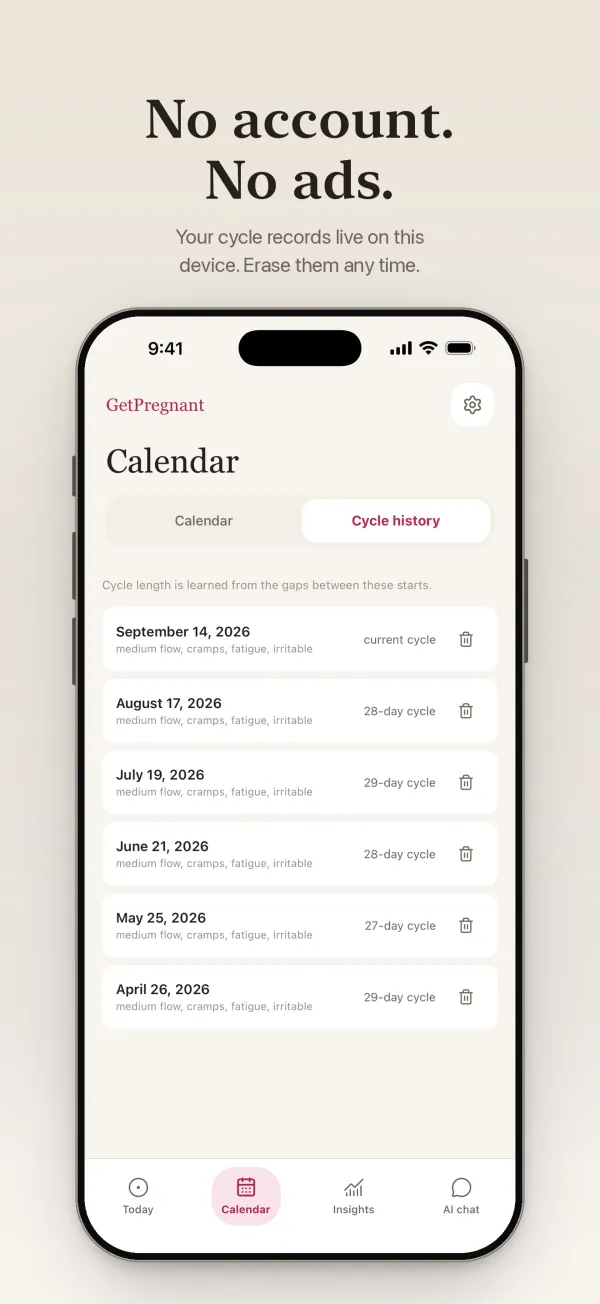
Your cycle history is saved only on your phone. There is no account and no cloud copy, so there is nothing for us to share or lose. Period apps have been penalised for sharing cycle data before: Flo (FTC order, 2021; $8M toward a $59.5M class settlement with Google and Flurry, 2025) and Premom (FTC order, 2023) among them. The optional AI chat sends only the records you agree to share, and only after you turn it on.
 Android first
GetPregnant
Your cycle,
in your pocket.
Android is on its way. iPhone will follow.
Inside the app
Five screens, one quiet routine.
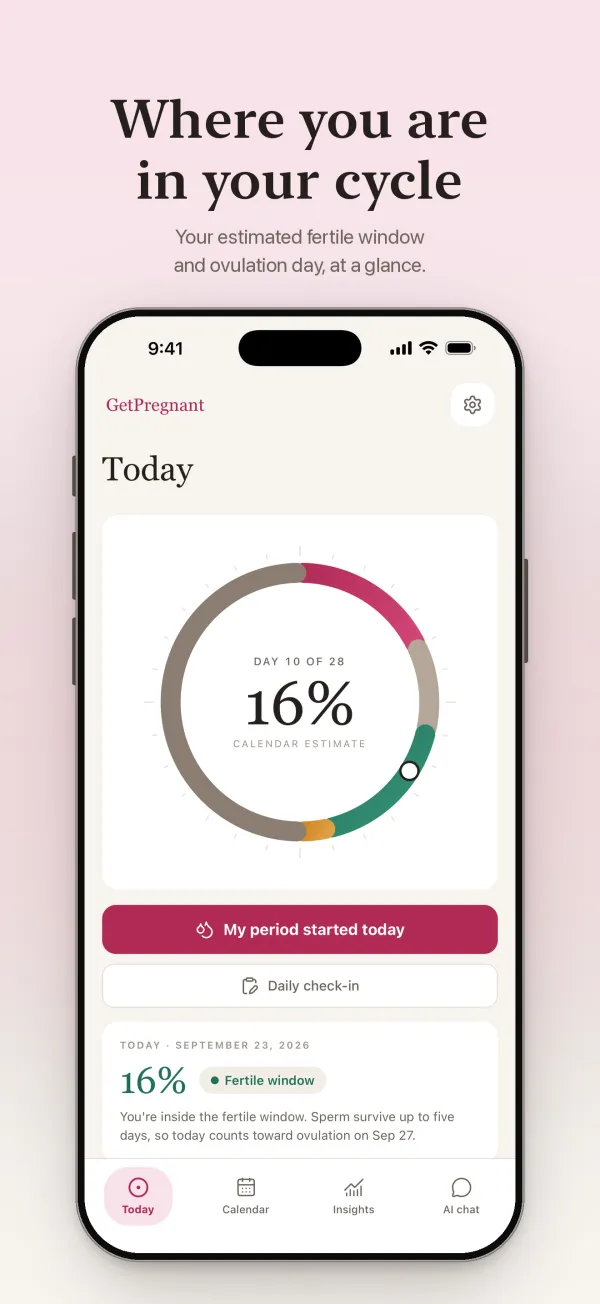
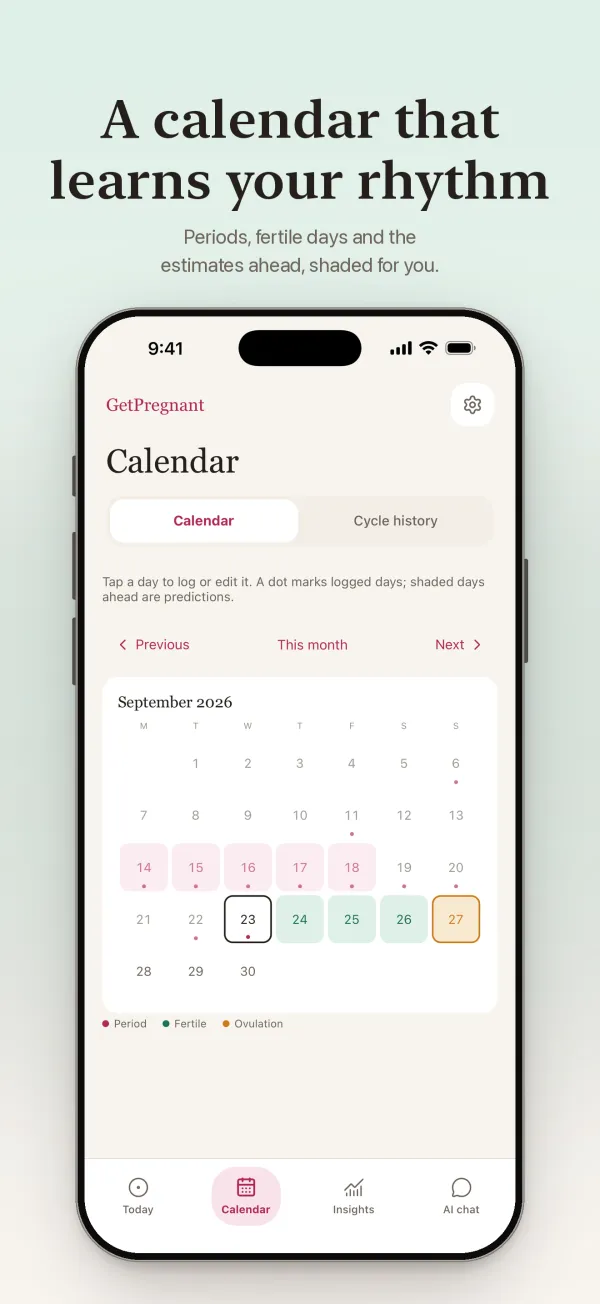
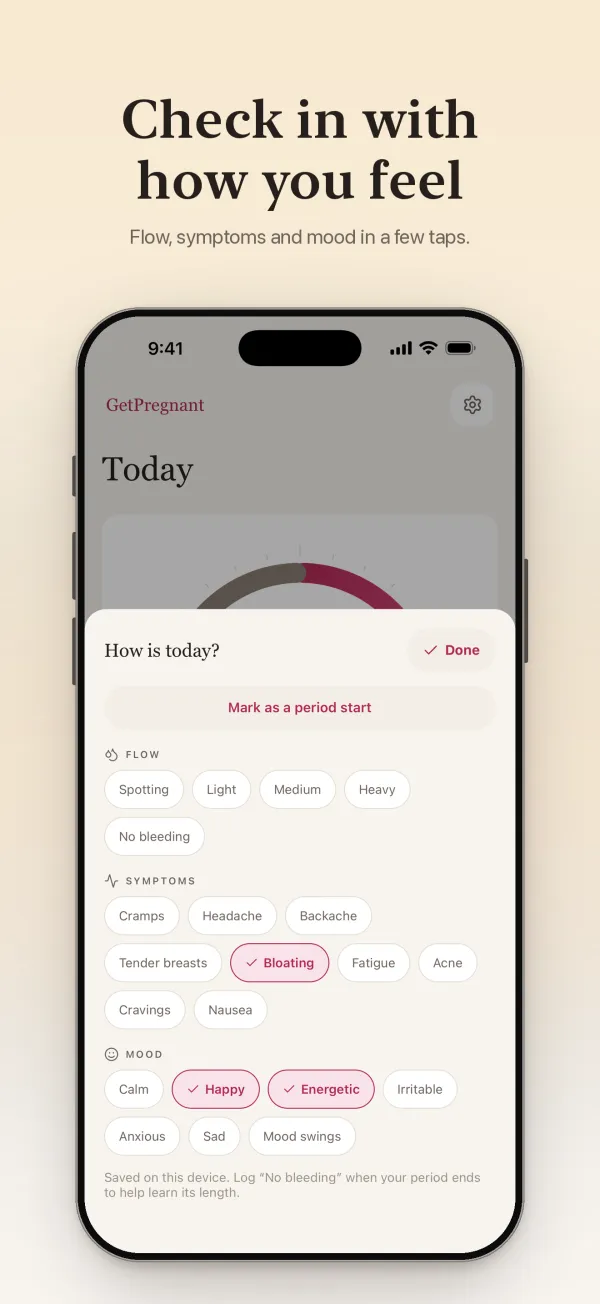
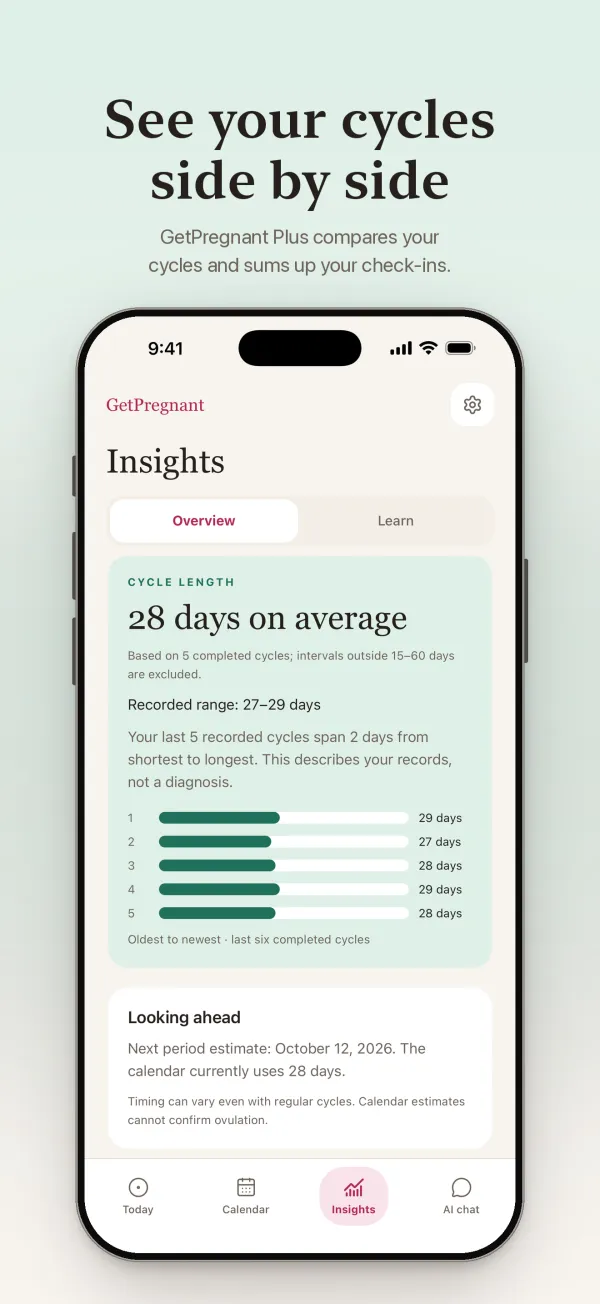
Privacy, compared
The biggest difference between period apps is not the algorithm. It is where your data lives.
Fertility data is about as personal as data gets: period dates, ovulation tests, basal temperature and intimacy. The big apps keep what you log on their own servers, and then have to promise, in a policy they can change at any time, that they will treat that data well. Promises have not always held. The U.S. Federal Trade Commission ordered Flo to stop sharing sensitive health data with Facebook and Google after it already had, and in 2025 Flo paid $8 million toward a $59.5 million class settlement (with Google and Flurry) over the same practices. The FTC barred Premom from sharing users’ health data for advertising in 2023.
GetPregnant is built the other way around. Your cycle history is stored in the app’s private storage on your phone. There is no account to create, no cloud copy to breach, no ad SDKs in the app, and nothing for us to hand over, sell, or lose in a breach, because we never receive it in the first place. The optional AI chat is the only feature that sends records off your device, and only after you switch it on and agree to what is shared.
| Trying to conceive? | GetPregnant | Flo | Clue | Premom |
|---|---|---|---|---|
| Account | None1 | Optional identity: free Anonymous Mode needs no name or email2 | Asked of every new user since 20193 | You register sign-in credentials4 |
| Who holds your cycle entries | Only your phone1 | Flo, with or without your identity attached2 | Clue’s EU servers, once you have an account3 | Premom, including cycle dates, test results and BBT4 |
| U.S. privacy enforcement | None | FTC order 2021; $8M toward a $59.5M class settlement 20255 | None found6 | FTC order 20237 |
- GetPregnant works without sign-up and keeps cycle entries in the app’s private storage on your phone; see our privacy policy. ↩
- Flo: Anonymous Mode lets people use the service “without any personally identifiable information, such as a name, email address, and technical identifier being associated with the account”, as a free feature; Flo’s Anonymous Mode page describes the health data you share with Flo either way. ↩
- Clue: “since 2019, we’ve been asking new joiners to create an account”; an account means “tracked data is securely stored on our EU-based servers”. ↩
- Premom’s privacy policy: “When you register for the App, you will be asked to provide credentials”, and the information it collects includes menstrual cycle dates, fertility test results and basal body temperature. ↩
- FTC: Flo Health shared sensitive health data with Facebook and Google (finalised order, June 2021). In the Frasco v. Flo Health class action, Flo agreed to pay $8 million, Google $48 million and Flurry $3.5 million, a $59.5 million fund (2025). ↩
- We found no FTC enforcement action against Clue or its maker, BioWink, as of September 2026. ↩
- FTC: Easy Healthcare (Premom) barred from sharing users’ health data for advertising, $100,000 civil penalty (May 2023). ↩
Claims describe these apps as their own pages and public records stated them in September 2026, and link to those sources. For exactly what we do and do not collect, read the privacy policy. Nothing about your cycle leaves your phone unless you turn on AI chat or export it yourself.